VERSION 0.6.1 ALPHA

AegisCLI Modular Recon Framework

A lightweight recon framework designed to eliminate tool-juggling hell. Native implementations with consistent CLI patterns across profiling, scanning, enumeration, and analysis — built for chaining, automation, and maintainability.

AegisCLI framework

Framework Architecture

AegisCLI follows a strict separation-of-concerns model with isolated modules, uniform interfaces, and zero global state. Every component is designed for predictability, extensibility, and real-world workflow integration.

aegiscli/cli

Central entry point responsible for command routing, argument parsing, and global flag resolution. Routes through Profiler_Selector rather than instantiating tool classes directly, following the aegiscli <module> <submodule> [flags] <target> pattern without carrying any state of its own.

core/utils

Runtime services shared across every module. logger.py handles timestamped logging to ~/.aegiscli/logs — JSON is the ground truth format when --log is active. exporter.py builds structured JSON envelopes for all tool output, while flagger.py manages verbose mode state without coupling to the CLI layer.

core/helpers

Presentation layer for terminal output. formatter.py provides color-coded styling, smart truncation for long data lists, and consistent section formatting — ensuring every module produces visually uniform output regardless of its data source.

aegiscli/tools

All recon capability lives here, fully isolated under tools/<module>/<submodule>. Currently active: profiler/ with WHOIS, DNS, and Web submodules; scanner/ with port.py and host.py. Planned: enumerator/, analyser/, and injector/ — each independently developed with no cross-module dependencies.

Entry Point
CLI
Command Router
Core Utilities
Logger
Flagger
Formatter
Exporter
Tool Modules
Profiler
Active
WHOIS DNS Web
Scanner
In Progress
Port Host UDP
Enumerator
Planned
Dirs Files Subdomains
Analyser
Planned
APIs OSINT Reports
Zero Global State
Isolated Modules
Uniform Interfaces

Current Features

Scanner Module NEW

  • Host Discovery — ICMP echo (raw sockets, provides TTL), TCP fallback on ports 22/80/443 for no-root environments, CIDR range support, TTL-based OS fingerprinting
  • Port Scanner — async TCP connect via asyncio, semaphore-controlled concurrency (400 cap), flexible port targeting
  • Banner grabbing — passive read (SSH, FTP, SMTP, Redis etc.), HTTP GET probe, SSL/TLS upgrade with SNI
  • Service Discovery — banner strings parsed into structured identity (protocol, software, version); included in JSON log output alongside raw banner; service is null when banner is empty or unrecognised
  • Two-step detection — plain TCP confirms open status, banner grab fully decoupled
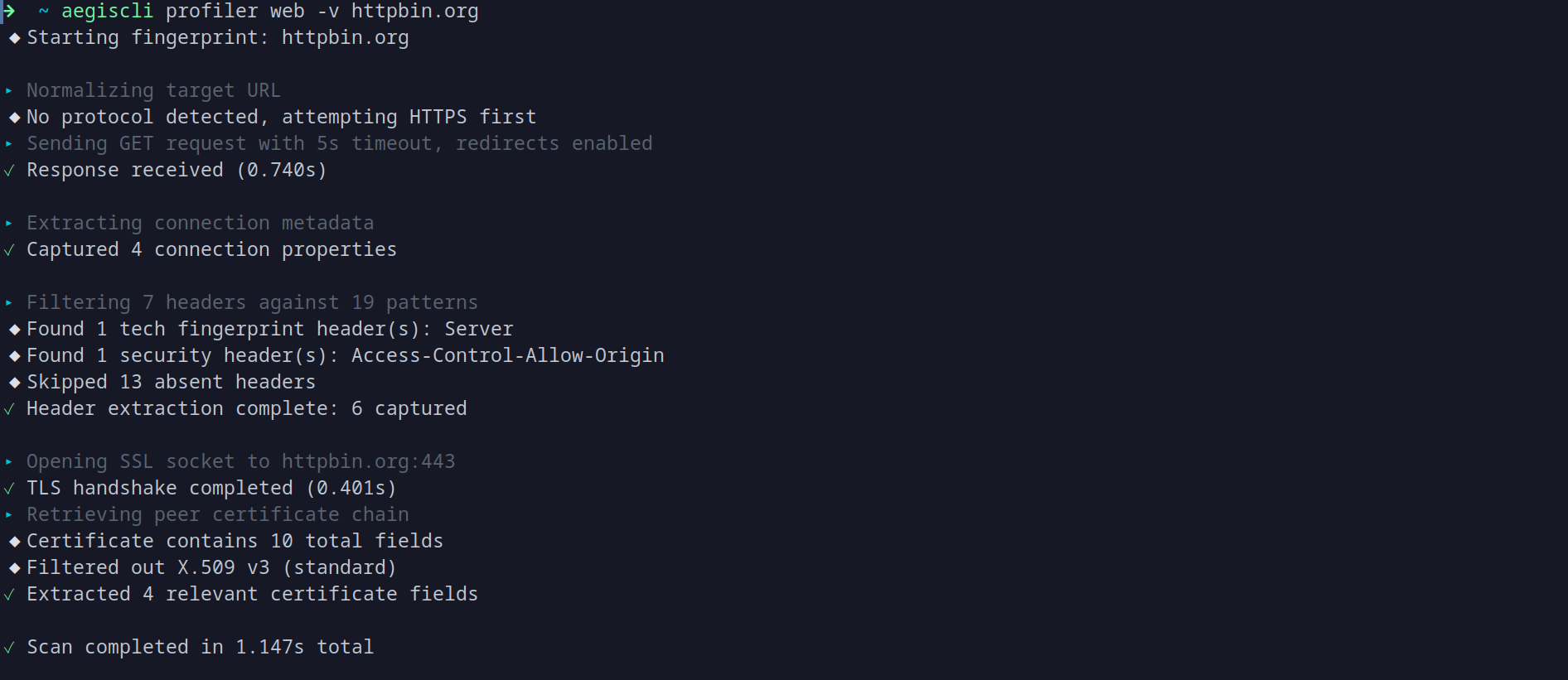
  • Verbose diagnostics across both submodules — per-host method/result, per-port banner status

Profiler Module

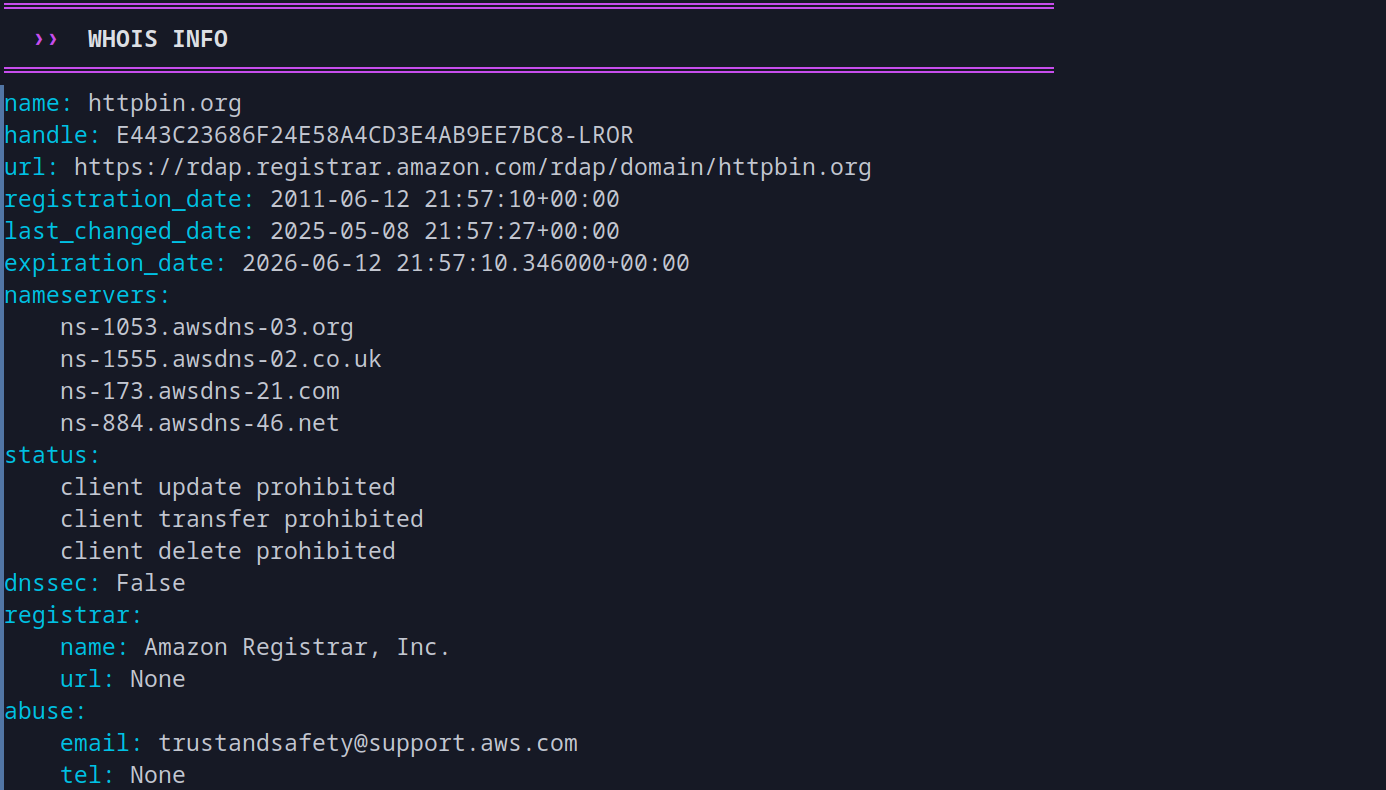
  • WHOIS / RDAP Lookup with intelligent fallback
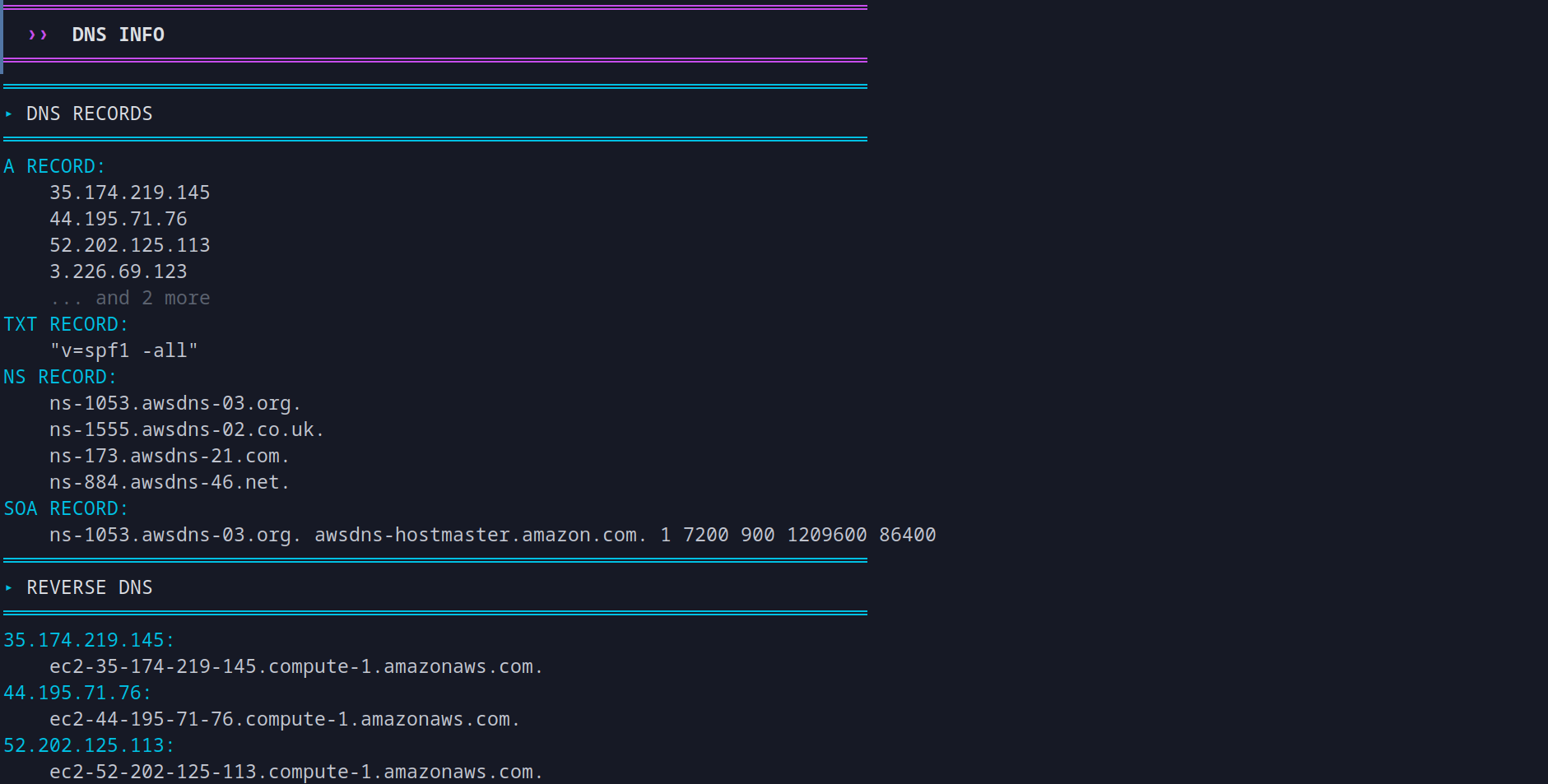
  • DNS Resolver (A/AAAA, MX, TXT, NS, CNAME, SOA)
  • Reverse DNS (PTR) Lookups
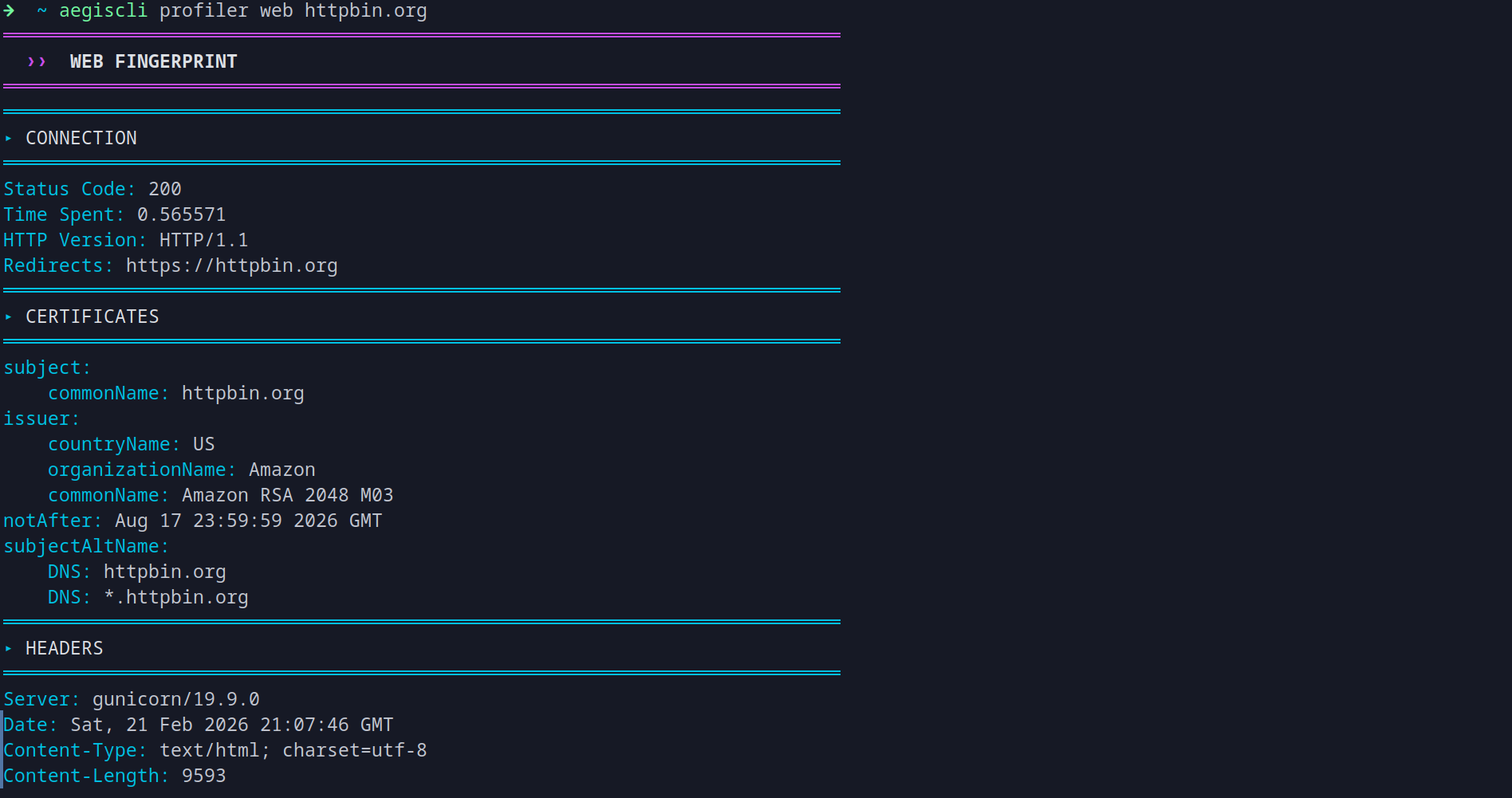
  • Web Fingerprinter with SSL/TLS inspection
  • HTTP header profiling and cookie parsing

Framework Capabilities

  • Verbose Mode (-v) for step-by-step execution
  • Structured JSON logging (--log) to ~/.aegiscli/logs
  • Centralized color-coded terminal output
  • ABC-enforced submodule contracts — fetch(), display(), export(), result()
  • Packaged as pip-installable Python project

Design Principles

  • No global mutable state
  • Isolated tool modules with uniform ABC interfaces
  • Errors always visible — never silently swallowed
  • Predictable output for automation and scripting
  • Consistent CLI patterns across all modules

Usage Examples

// Interactive Demo

$ aegiscli profiler whois -v example.com
Querying WHOIS for example.com...
Domain: example.com
Registrar: IANA
Status: clientTransferProhibited
$ aegiscli profiler dns --log example.com
Resolving DNS records...
A: 93.184.216.34
AAAA: 2606:2800:220:1:248:1893:25c8:1946
Logged to ~/.aegiscli/logs/dns_20250217.log
$ aegiscli profiler web httpbin.org
Fingerprinting httpbin.org...
Status: 200 OK
Server: gunicorn/19.9.0
! Warning: HSTS header missing
$ aegiscli scanner host -v --log 192.168.1.0/24
Hosts: 254 | ICMP: available | Concurrency: 100
192.168.1.1 alive TTL 64 Linux/macOS
192.168.1.5 alive TTL 128 Windows
192.168.1.20 alive TCP:80 (no root)
Logged to ~/.aegiscli/logs/scanner_host_20260317.json

// Output Examples

Future Plans

Short-Term

Immediate Priorities

  • Web Fingerprinter upgrade — deeper tech stack detection, framework fingerprinting
  • Scanner udp.py — UDP port scanning
  • Upgrade dns and whois submodules to actively interact with their discovery and dig deeper
Medium-Term

Core Expansion

  • settings.json configuration engine — user-configurable defaults for concurrency, timeouts, output behavior, and module-specific parameters
  • Enumerator module with ffuf or gobuster integration
  • Analyser module (third-party API enrichment — Shodan, VirusTotal, Censys, and more)
Long-Term

Advanced Features

  • Full blown tool chaining system
  • Injector module (SQLi testing, payload logic)
  • Log Analyser
  • Plugin ecosystem

Project Philosophy

AegisCLI is built intentionally as a framework. The priority is long-term stability, modular expansion, and real-world workflow integration.

Practitioner Workflow First

One tool replaces many. WHOIS, DNS, fingerprinting, scanning, and enumeration under a single consistent interface.

Architecture-First Development

Every decision prioritizes structural integrity and long-term maintainability over quick feature additions.

Minimize Complexity

Simple, isolated modules with clear boundaries. No hidden dependencies or unexpected side effects.

Strict Readability Standards

Code is written for humans first. Every function, module, and output is designed for clarity.

Incremental Refinement

Slow, deliberate progress over rushed releases. Each version builds on a solid foundation.

Predictable, Consistent Behavior

Uniform interfaces and output formats enable seamless automation and scripting integration.

Licensed under AGPLv3

Ensures full code transparency and enforces openness at every level — including network use. Any derivative work, modification, or hosted deployment must retain the same license and publish its source.

Free to use Free to modify Source must stay open Network use = distribution Attribution required Copyleft

Ready to streamline your recon workflow?

AegisCLI is actively developed and improving with each release. Join the project, contribute, or start using it in your security workflows today.

Complete documentation coming soon All the info you need right now is already on this page.